
One library, not the open internet.
The corpus behind every answer: peer-reviewed studies drawn from hundreds of medical journals, chapters from leading evidence-based nutrition books, and the complete NutritionFacts.org library of videos and articles. Indexed, cross-referenced, and refreshed continuously. When you ask a question, the coach searches this corpus and nothing else.
One question, answered from the corpus
Yes, increasing your fiber intake can indeed contribute to a longer lifespan. Long-term studies, such as the Harvard Nurses' Health Study, which followed over 100,000 women, have identified dietary fiber as a significant factor associated with lower overall mortality [1], [2]. Here's how fiber supports longevity:
- Reduced Disease Risk: Fiber intake is consistently linked to a lower risk of cardiovascular disease, type 2 diabetes, and certain cancers [1]. These are major contributors to mortality.
- Anti-inflammatory Effects: When you consume whole grains and other fiber-rich foods, the beneficial bacteria in your gut ferment this fiber, producing short-chain fatty acids like butyrate. These compounds exert broad anti-inflammatory effects throughout the body, contributing to overall health [3].
- Improved Gut Health: Fiber promotes a healthy gut microbiome, which is increasingly recognized for its role in immune function, metabolism, and even brain health.
To increase your fiber intake, focus on whole-food plant-based sources like legumes, whole grains, fruits, and vegetables.
A real exchange, unedited. Every source comes from the corpus behind the coach: evidence-based videos, articles, and book chapters, each one open to you.
Five factors, weighted.
Not all studies deserve equal trust. Every claim is graded with our house rubric, informed by GRADE, the framework used by the WHO, Cochrane, and clinical guideline bodies worldwide. Five factors, each weighted, combine into a single grade:
- Study type35%Study type
A meta-analysis of randomized trials outranks a single trial; human studies outrank animal and lab work. The stronger the design, the higher the score.
- Consistency25%Consistency
Do independent studies point the same way? Broad agreement scores high. Real dissent is flagged, never hidden, and single-study claims are marked as exactly that.
- Effect size15%Effect size
A meaningful effect on a hard outcome such as mortality, heart attacks, or cancer counts for more than a small shift in a lab value.
- Sample size15%Sample size
Findings from tens of thousands of people across multiple populations carry more weight than a study of forty volunteers.
- Conflicts of interest10%Conflicts of interest
Independently funded research scores higher than industry-funded studies whose results happen to favor their sponsor.
The weights are our own editorial rubric, not a GRADE standard. We publish them so you can judge our judgment.
Four grades, and a ceiling.
- Strong
Strong, consistent evidence from high-quality human research. You can act on this.
- Good
Good evidence with minor gaps. Solid ground; watch for updates.
- Limited
Limited or mixed evidence. Interesting, not settled.
- Early
Weak or early-stage evidence. We say so plainly.
Four checks between a claim and your screen.
Citations in Evidalife are mandatory and machine-checked. This is the path an answer walks before you read it:
Your question
Every factual answer starts with retrieval: the coach searches the corpus for the studies, chapters, and articles that bear on your question.
- 01
Must cite
The coach is bound to cite its sources. Answers without references are not allowed to make factual health claims.
- 02
Real sources only
Every reference is drawn from what was actually retrieved: real papers and chapters with titles, authors, and links. Never generated from memory.
- 03
Checked before you see it
Each citation marker is matched against the retrieved sources. A marker that matches nothing is stripped before the answer reaches you.
Unmatched marker: dropped - 04
Audited after the fact
An independent validator re-reads each cited source and asks: does it actually support this claim? Failures are logged and reviewed.
Deep Research
For the big questions, a chat answer is thin. Ask for a Research Dive and the coach works through the corpus systematically, weighing study quality and surfacing disagreement, then returns a saved, shareable report with an executive summary and every source cited.
- Does creatine improve cognition in older adults?
- Time-restricted eating and sleep quality: what does the evidence say?
- Omega-3 and atrial fibrillation: benefit or risk?
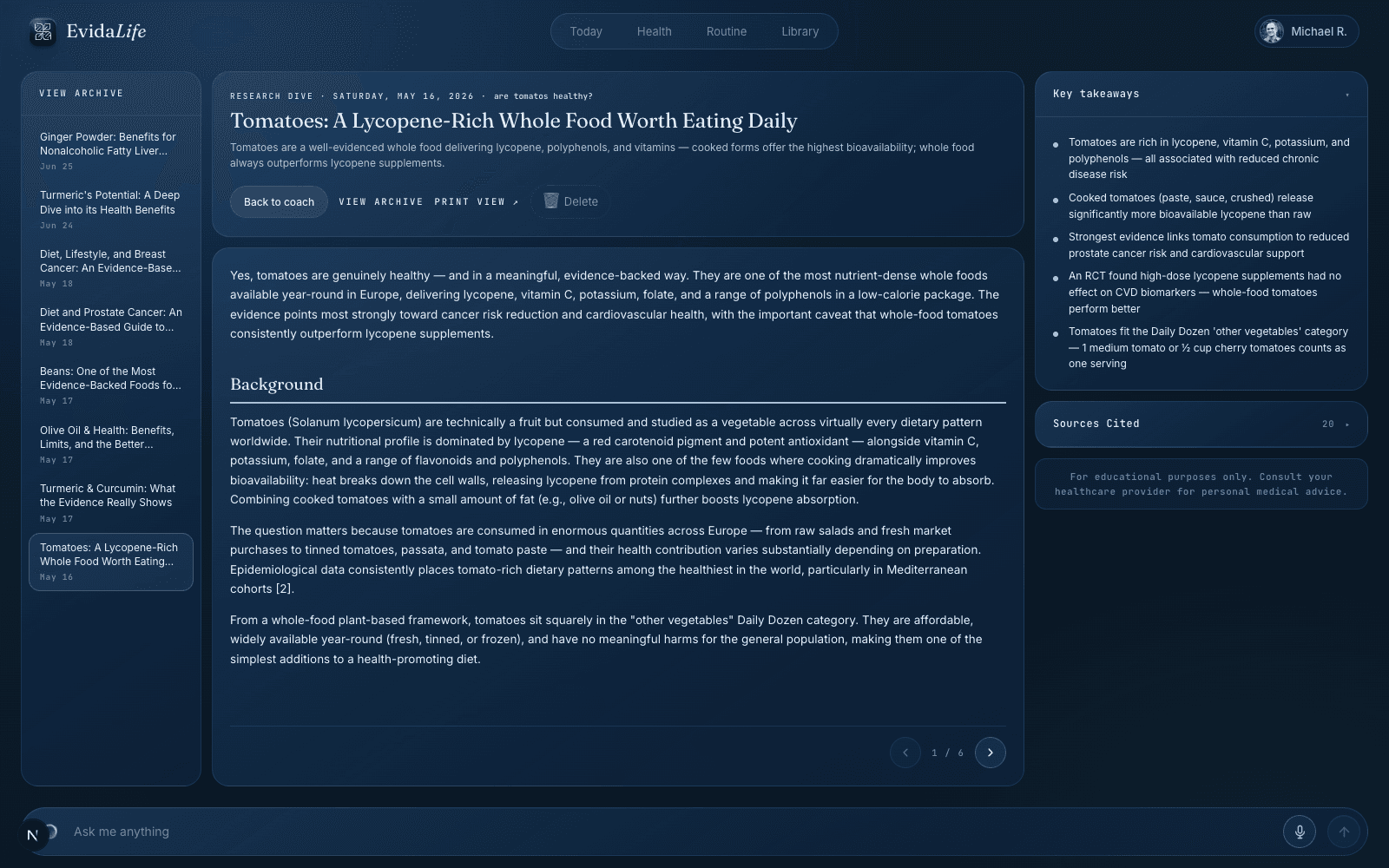
A real Research Dive in the app. Demo profile.
Built to be checked.
No supplement sales, no sponsors, no pay-to-rank. Nobody can buy their way into an answer.
The coach is constrained to the corpus. If the research doesn't support a claim, the coach doesn't make it.
You will read 'may' and 'suggests' here, not miracle claims. Where the evidence is thin, we say so.
When we are wrong, the correction goes up on this page, dated, and it stays: a wrong citation, a claim the evidence no longer supports, a grade that moved. The policy has been in effect since launch on 14 June 2026. There are no entries yet; the first will appear right here.
Not medical advice. Evidalife informs and educates; for diagnosis and treatment, talk to your doctor.