Health advice is everywhere. Receipts are rare. Here is how an EvidaLife answer is made, how sure we are, and what we suggest you do.
How an answer is made
Find, grade, then answer.
Find
The studies that fit your question
We search 57,000+ peer-reviewed studies from 4,500+ journals. The ones that answer your question most directly come first, so a small trial on exactly your topic can outrank a big study about something else.
Grade
Two letters, kept apart
Each finding gets an Evidence letter (how sure we are) and an Advice letter (what we suggest). The same rules apply to every study, written down in advance.
Answer
Every sentence, sourced
The coach cites each study it uses and says where the evidence is thin. If the research doesn't support a claim, it doesn't make it.
57,000+
peer-reviewed studies
4,500+
journals
360
markers explained
8
languages
One question, followed through
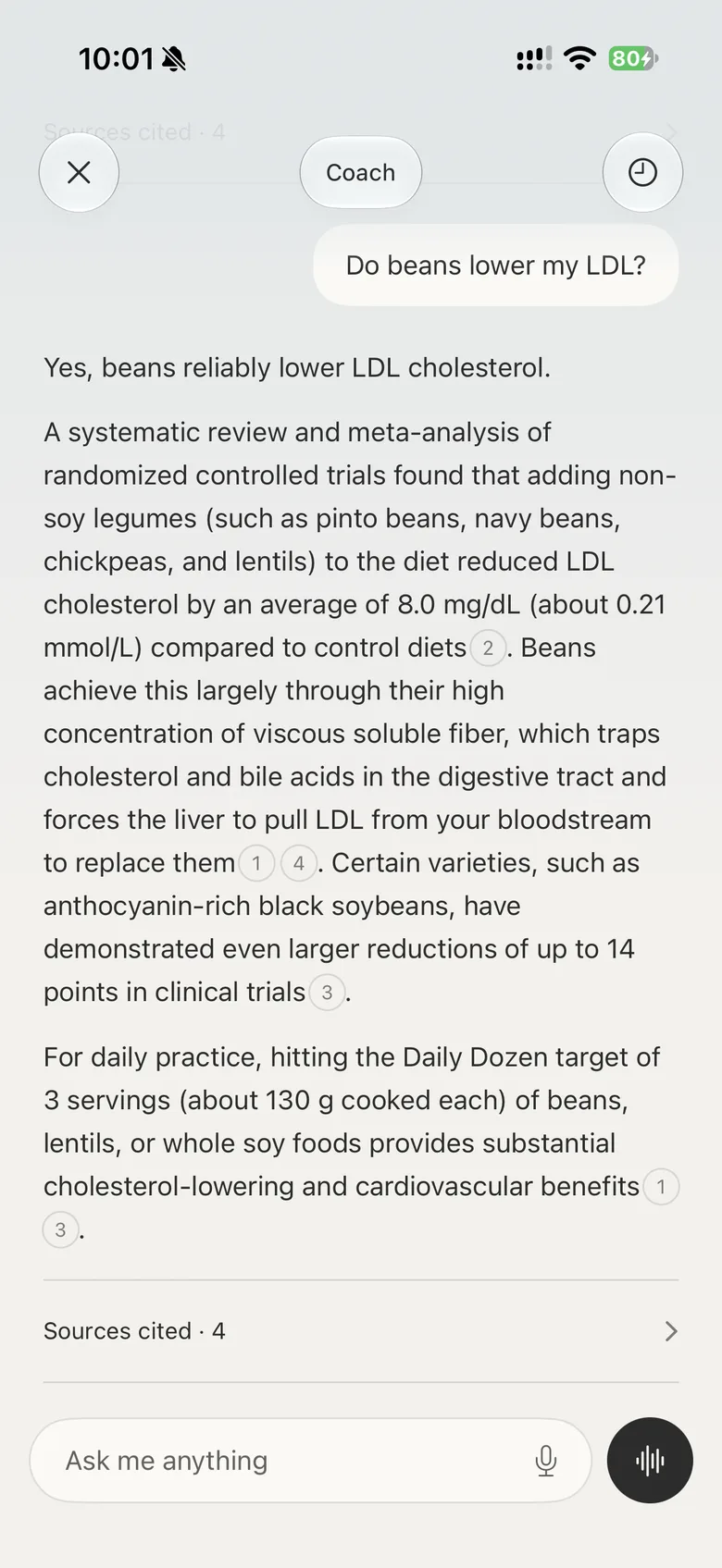
“Do beans lower my LDL?”
1 · Find
The studies that answer it
Trials that fed people beans and measured LDL, and the reviews that pooled them. Studies that only mention beans in passing drop out.
Trials and meta-analyses first
2 · Grade
How sure, and what to do
Many trials, the same direction, a modest effect: Evidence B. Cheap, safe and easy to try: Advice A.
B Evidence · A Advice
3 · Answer
In plain words, with sources
The answer explains in plain words what the trials found and how big the effect is, then suggests a next step. Each sentence links to its study.
The answer, each claim linked to its source
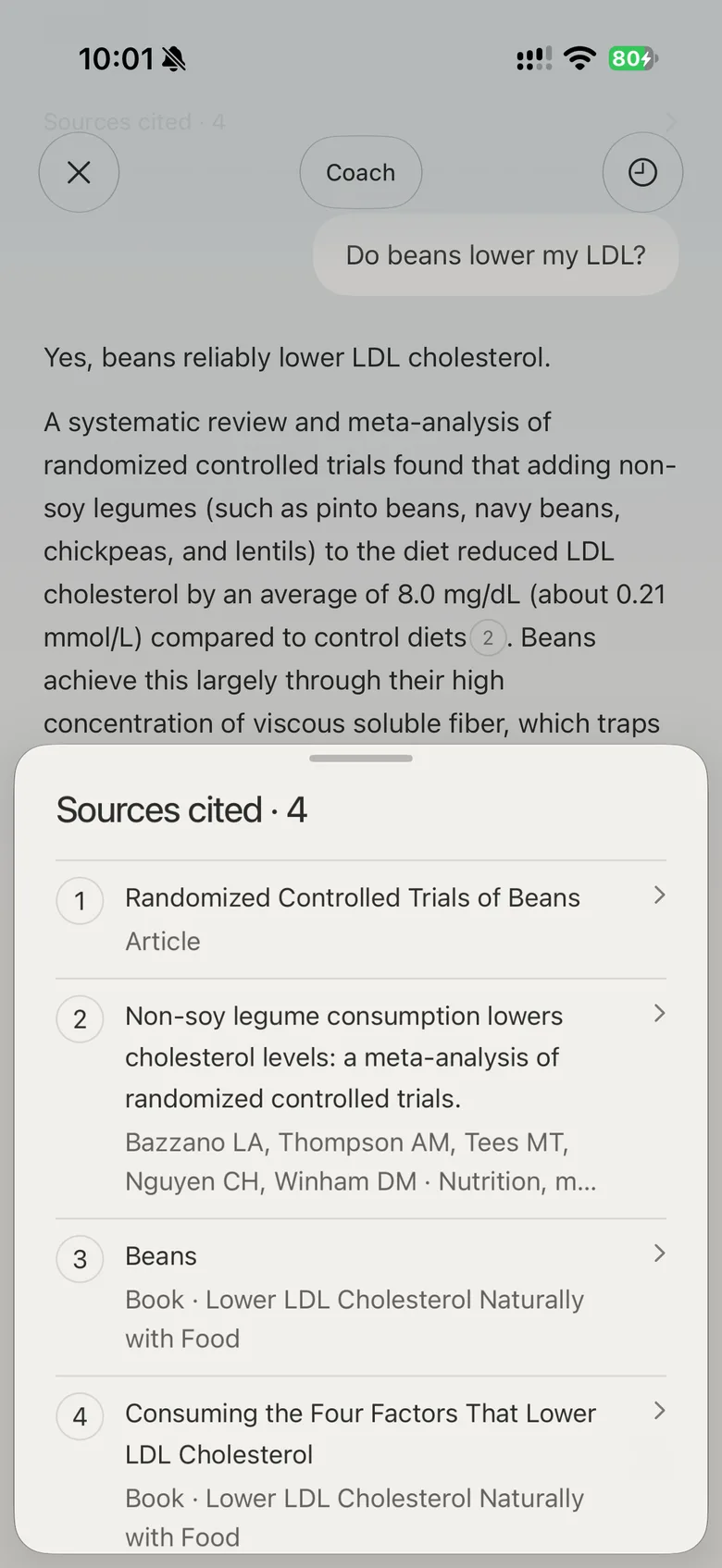
Sources cited · 4: the trials, the meta-analysis and the book
Which studies count most
Not every study weighs the same.
A pooled review of many trials tells us more than one small study, and a study in people tells us more than one in cells. The coach leans on the strongest kind there is for each question, and says so when only weaker kinds exist.
Evidence: how sure are we?
A to D. Set by the kind and number of studies.
≠
Advice: should you do it?
A to D. Set by the evidence and by the risk, cost and gain.
The evidence pyramid
Higher means more certain.
Meta-analyses and reviews
Randomised trials
Large cohort studies
Case-control and smaller studies
Lab and animal studies
How we give advice
How sure we are, against how much it could cost you.
Low risk or costReal risk or cost
Sure
ADo itBeans for LDL · B / A
B or CWorth weighing
Unsure
A or BWorth tryingLifestyle programme · C / A
C or DNot yet, or avoidMulti-day fasting · D / C
When the evidence changes
So do the answers.
New studies are added to the library over time, and each answer is built from the library as it stands when you ask. So when a stronger study changes the picture, new answers change with it. Nothing is kept just because we said it before.
How we grade
How sure are we, and what should you do?
Evidence is how sure we are that something works. Advice is whether we think you should do it. A cheap, safe step can be worth taking even when the proof is thin. A risky one may not be, even when the proof is strong.
So you always get two letters, and we never blend them into one score.
Evidence
How sure we are that it's true. Based on study design, risk of bias, consistency, and how directly the studies answer the question.
AHigh. New research is very unlikely to change this.
BModerate. Probably right; details may shift.
CLow. Promising, but few or small studies.
DVery low. Early signals only.
Advice
What we suggest, weighing the likely benefit against harms, cost and effort.
ADo it. Clear benefit, little downside.
BWorth trying. Likely helps; your call.
CNot yet. Wait for better evidence.
DAvoid. Harm likely outweighs benefit.
Three examples
Lifestyle change for early prostate cancer
CEvidenceAAdvice
5% vs 27%
needed surgery, radiation or hormone therapy within 2 years (programme vs usual care)
Whole plant foods, daily walks and stress care, studied in men with early prostate cancer. PSA went down, and fewer men needed treatment.
Why these letters: the trial was small and hasn't been repeated in a large trial or meta-analysis, so we can't be very sure (C). But the change is cheap, low-risk and good for the heart too, so we say do it, alongside the care your doctor plans, never instead of it (A).
Frattaroli et al., Urology 2008 · Ornish et al., J Urol 2005 · PubMed ↗ · PubMed ↗
A daily serving of beans
CEvidenceAAdvice
−6%
lower risk of death with more beans and lentils, pooled from 32 cohorts and 1.1 million people
Beans, lentils and chickpeas, eaten every day.
Why these letters: dozens of large studies across many countries link them to longer life, but most follow people over time rather than test them in a trial, so low (C). They're cheap, safe and filling: do it (A).
Meta-analysis, Advances in Nutrition 2023 · PubMed ↗
Fasting for several days to slow ageing
DEvidenceCAdvice
Mostly animals
few human trials, all short; the rest comes from animal studies
Water-only fasts of three days or more, for longevity.
Why these letters: the signals come mostly from animal studies and very short human trials (D). Long fasts carry real risks without a doctor, so: not yet (C).
When the evidence is small but the downside is small too
48 people. Five years. Arteries that opened.
In the Lifestyle Heart Trial, people with coronary heart disease ate a whole-food plant-based diet, walked, managed stress and met as a group. Their artery narrowing went down while the control group’s went up, and they had fewer cardiac events.
The trial was small, so it can’t earn a high Evidence letter. But the changes are food, walking and stress care: few side effects, low cost, and a possible upside against the leading cause of death. That is why the Advice letter can be A while Evidence stays at C.
Evidence C · one small trial and its follow-upAdvice A · little downside, real upside
HbA1c fell 0.96 points (standard diabetes diet: 0.56). For 43%, the study doctors could reduce diabetes medication.
Barnard, a different team · Diabetes Care · 99 people · low-fat vegan diet · PubMed ↗
2024
Early Alzheimer's
After 20 weeks, memory and daily function improved on some measures. In usual care they got worse.
Ornish · Alzheimer's Res Ther · 51 people · PubMed ↗
No single pill has been shown to help against heart disease, prostate cancer, diabetes and memory loss at once. And the side effects are the ones you want: in the diabetes trial, 6.5 kg lighter and LDL down 21%.
Each trial is small, so each one is Evidence C. The advice is still A: little risk, large possible gain. That is the difference between the two letters.
What we eat, and why
Whole food, plant-based. Easy on salt, oil and sugar.
The strongest research on long, healthy lives points to the same plate: vegetables, fruit, beans, whole grains, nuts and seeds, as close to how they grow as possible. Fans call it WFPB-SOS. We just call it eating well.
It's a direction, not a rulebook. Olives beat olive oil, but a splash of oil in a weeknight dinner won't undo a good week. Most people start by adding: a bowl of beans, a handful of greens. The coach shows you the studies, and you decide how far to go.
Every answer, cited
Open the study behind the sentence.
Answers name their sources. Tap one to read the passage, the study type and the journal.