The most boring longevity food in the world
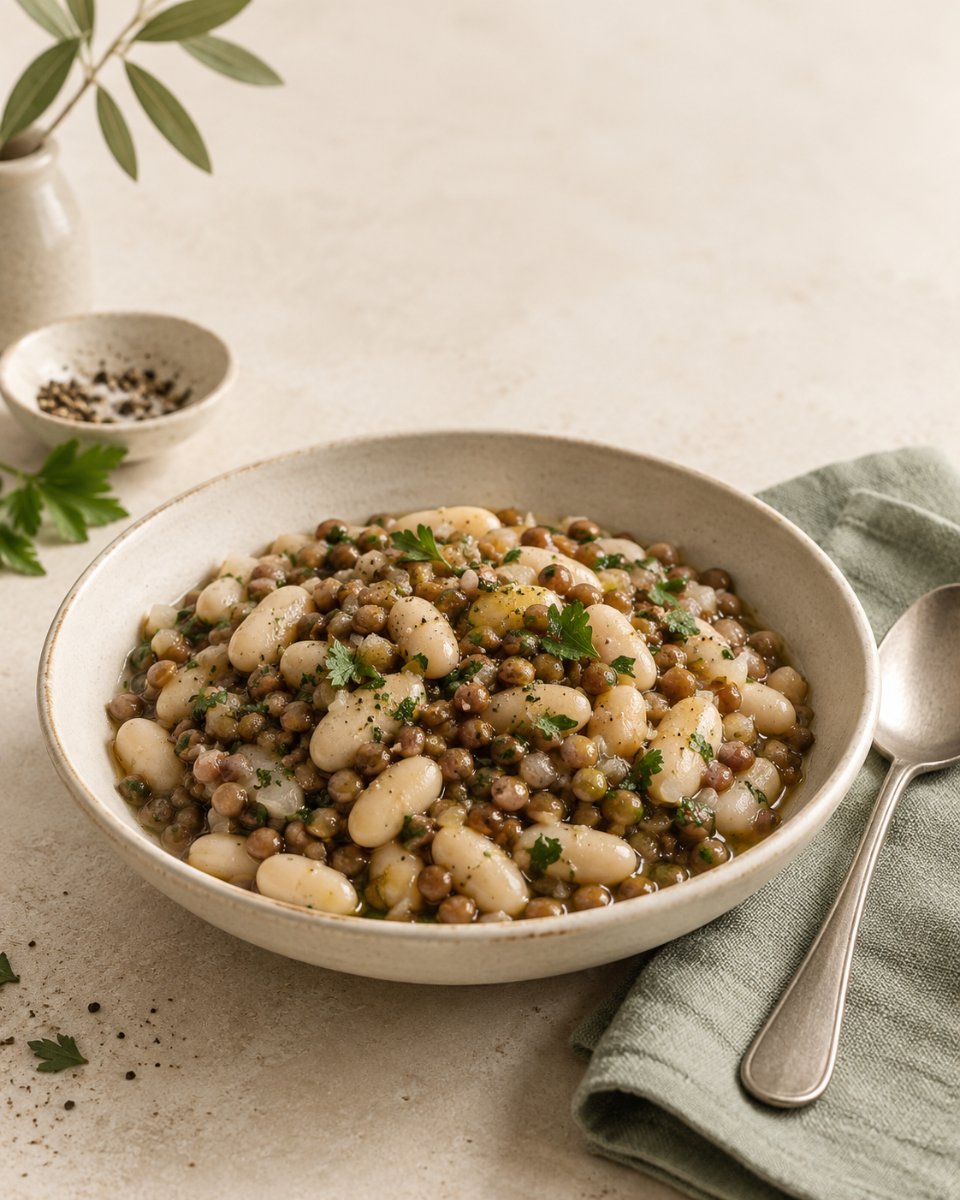
Beans do not look like a longevity intervention. There is no patent, no proprietary extract, no eye-watering price tag — just a can of something your grandmother probably kept in the pantry. Which is exactly why the data are so disarming. When researchers went looking for the single dietary factor that best predicted who would still be alive years later, across very different cultures, the winner was not a superfood, a supplement, or a spice. It was the humble legume.
In the Food Habits in Later Life study — an analysis of 785 adults aged 70 and older drawn from cohorts in Japan, Sweden, Greece, and Australia — legumes were the one food group that consistently predicted survival across all of them. Every extra 20 grams per day of legumes was associated with a 7-8% reduction in the risk of dying over the following years, independent of ethnicity, smoking, and age 1. This was a statistical association in an older population, not proof that beans themselves caused longer survival. Twenty grams was the increment analysed; it was not a prescribed serving or an established threshold for benefit. So let us do what Evidalife always does with a tidy story: pull on the threads.
In the FHILL cohorts, higher legume intake was associated with lower mortality; other food groups did not consistently predict survival. 1Editorial summary of Darmadi-Blackberry et al. (2004)
It is not just one striking cohort
A single quotable number is easy to over-read, so the more useful question is how other populations and outcomes fit the picture. In the NHANES I Epidemiologic Follow-up Study, 9,632 US men and women were tracked for an average of 19 years. Those who ate legumes four or more times a week had a 22% lower incidence of coronary heart disease, and an 11% lower incidence of cardiovascular disease overall, compared with people who ate them less than once a week — after adjustment for risk factors. 2
Among more than 34,000 California Seventh-day Adventists, the cited review reported associations between legumes and lower colon-cancer risk in nonvegetarians and lower pancreatic-cancer risk. Its heart-disease findings concerned vegetarian patterns, nuts and whole-grain bread; it does not establish a legume-specific heart-disease benefit. 3
In an observational analysis within PREDIMED, greater adherence to a provegetarian eating pattern was associated with lower all-cause mortality. This evaluated a broader plant-rich pattern, not an isolated randomized effect of beans. 4 In a 2020 dose-response meta-analysis of 32 cohort studies and 715,128 participants, an additional 3% of daily energy from plant protein was associated with about 5% lower all-cause mortality. Again, this was plant protein generally, rather than a bean-only result. 5
These findings support legumes as part of a plant-rich eating pattern, while leaving uncertainty about the effect of an individual serving. The FHILL estimate describes an association per additional 20 g of daily legume intake in older adults; it should not be converted into a guaranteed percentage benefit for every serving or every person. 1
Why a bean would move the needle
A fair skeptic wants a mechanism, not just a column of hazard ratios — and legumes have several plausible ones. Nutritionally they are unusual: they are one of the few foods that combine slowly digestible carbohydrate, soluble fiber, resistant starch, and plant protein in a single package 7. That combination shows up downstream in the exact risk factors that track with cardiovascular aging.
- Cholesterol. A meta-analysis of 10 randomized controlled trials in 268 participants found that diets rich in non-soy legumes — beans, lentils, peas — lowered LDL ("bad") cholesterol by an average of about 8 mg/dL versus control diets 8. A broader review of dry-bean and soybean trials reached the same conclusion: regular bean intake can meaningfully lower serum cholesterol 9.
- Blood pressure. Pooling eight controlled feeding trials in 554 adults, swapping pulses in for other foods (calorie-for-calorie) was associated with roughly a 2.25 mm Hg drop in systolic blood pressure 10.
- Blood sugar. A meta-analysis of 41 controlled trials found that pulses — eaten alone or inside low-glycemic-index or high-fiber diets — improved fasting glucose, insulin, and longer-term markers such as HbA1c 11.
Two deeper threads tie these together. The first is fiber. In a BMJ dose-response meta-analysis of prospective cohorts, higher dietary fiber intake was associated with significantly lower rates of coronary heart disease and cardiovascular disease, in a graded relationship 12 — and beans are one of the densest fiber sources in the diet. The second is the legume "package effect": a review of the nutritional quality of legumes concluded that their blend of fiber, plant protein, resistant starch, minerals, and polyphenols plausibly underlies their role in lowering cardiometabolic risk, rather than any single magic ingredient 13. None of these are dramatic one-shot effects.
Greger highlights a trial in people with type 2 diabetes in which a cup of legumes a day for three months improved longer-term blood-sugar control and reduced resting heart rate by about 3.4 beats per minute. His comparison with roughly fifty hours of treadmill exercise comes from separate studies, rather than a direct beans-versus-exercise trial. This is a risk-factor finding, not proof that the heart-rate change itself lengthens life. 14
Where the evidence honestly thins
It would be easy to let a neat story sprint ahead of the data, so here is the other side — and it matters.
- The survival evidence is observational. It establishes association, not proof of cause. Dietary habits cluster with other behaviours, and statistical adjustment cannot eliminate every alternative explanation. FHILL is a cohort study; the provegetarian analysis within PREDIMED also assessed an observed dietary pattern, even though the parent study randomized diets. 14
- The estimates are population averages. The association per extra 20 g of legumes does not predict an individual person’s benefit or establish an optimal serving size. 1
- Risk-factor trials do not prove longevity. The cholesterol and blood-pressure reviews describe modest changes in surrogate outcomes. The glycaemic review found substantial variation between trials. These results offer plausible mechanisms, but cannot show how many additional years of life beans provide. 81011
Taken together, the cohorts and trials support including legumes in a varied eating pattern, with the evidence strongest for associations and modest changes in selected risk factors. They do not justify a guaranteed longevity claim.
How to actually use this
Greger’s Daily Dozen target is three servings a day. He defines a serving as half a cup of cooked beans, lentils, split peas, tofu or tempeh, or a quarter cup of hummus. 21 This is his practical framework; the cohort findings do not establish an optimal dose or guarantee a particular benefit from the first serving. 1
- Make the meal easy. Try lentils in soup, beans on a salad or in a grain bowl, hummus with vegetables, or a bean chili.
- Use canned beans when convenient. Draining and rinsing lowers their sodium content, although the amount varies by product and preparation. 20
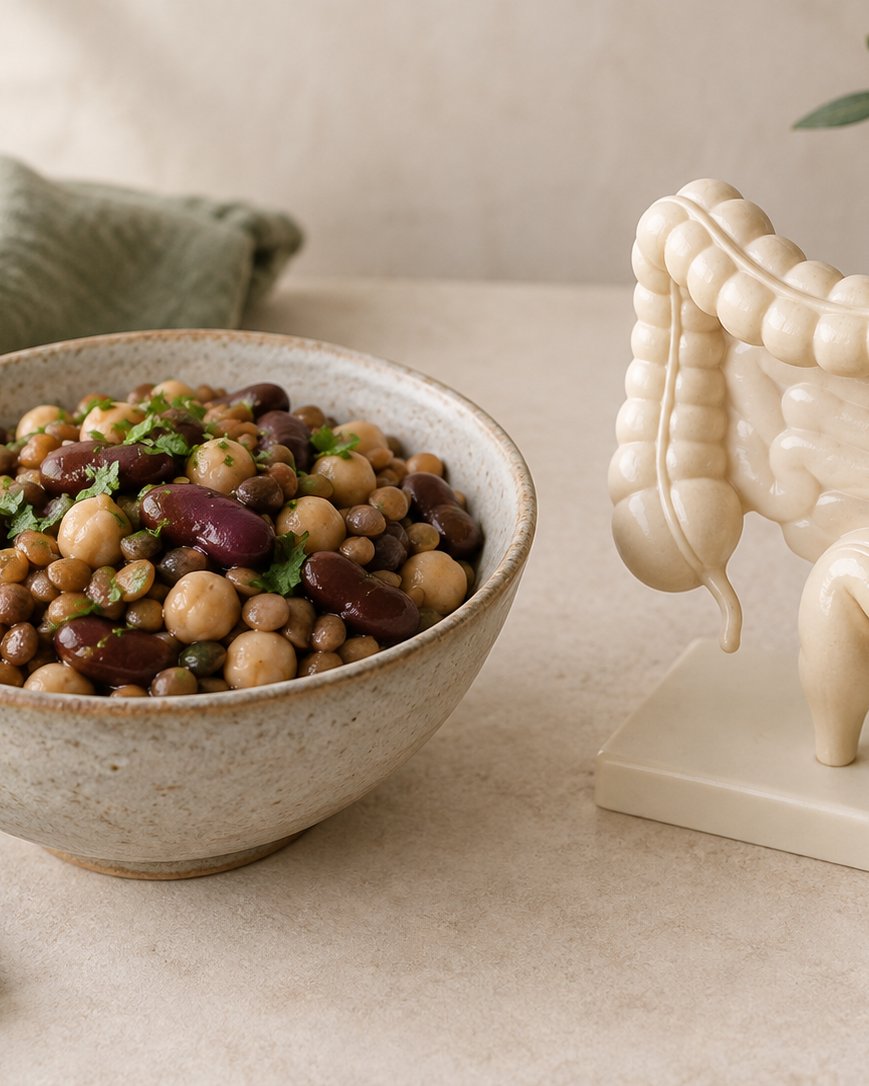
- Pay attention to tolerance. Legume carbohydrates can be fermented by gut bacteria and produce gas; some also have prebiotic effects. Start with a portion you tolerate and adjust gradually. 19
The bottom line
Legume intake has been associated with lower mortality in the FHILL cohorts and lower coronary heart-disease incidence in NHANES I. Broader plant-rich patterns also show favourable associations. 124 Controlled trials offer plausible mechanisms through modest improvements in cholesterol, blood pressure and glucose control. 81011
The caveats matter: observational associations cannot prove cause, individual benefits cannot be predicted from population averages, and changes in risk factors do not establish extra years of life. Beans are a practical food to include, not a cure or a promise of longevity. Keep a few cans in the pantry and try adding a serving to a meal you already enjoy.
This article is educational and not medical advice. If you are managing a specific condition or take medication, discuss substantial dietary changes with your doctor or dietitian.